
All blogs
14.10.2026
-thumb.png)
Media
Millions of tourists or affluent new residents: What creates long-term value for Croatia? - Ivan Kovačić for Večernji list
Tourist arrivals, new accommodation capacity and rising property prices are often seen as indicators of success along Croatia’s coast. Yet a destination’s long-term value also depends on what happens beyond the tourist season. On the people who live there, the services they use and the everyday life that gives a place its identity.
Speaking to Večernji list, Ivan Kovačić, owner of Remington Real Estate, the exclusive affiliate of Christie’s International Real Estate in Croatia, explores the relationship between tourism, housing and development. His perspective raises an important question about the value that wealthy individuals can bring when they choose to make Croatia their home.
At the heart of this discussion is how Croatia uses the limited space along its coastline. Every new property serves a purpose, but it also influences its neighbourhood, the local economy and the destination’s future character.
Value that continues beyond the purchase
Kovačić describes a wealthy couple from London who wish to divide their retirement between the United Kingdom and Croatia. They plan to purchase a property worth several million euros and make Croatia their primary residence.
Their interest extends well beyond occasional holidays. They want to spend most of the year here, drawing on the wealth they have accumulated throughout their lives. However, as Kovačić explains, purchasing a property does not, in itself, give British or American citizens the right to long-term residence.
“In other words, Croatia is rather cautious towards people who want to come here, make a home and spend substantial private wealth.”
At the same time, considerable numbers of houses and apartments are being developed for short-term holiday rentals. Kovačić sees this contrast as a reason to reconsider development priorities.
A buyer who spends most of the year in Croatia gradually becomes part of local life. They have their own doctor, use local businesses, visit restaurants and build relationships with the people around them.
Their economic contribution continues long after the property transaction is complete. For the local community, the lasting nature of that presence and the continuity of spending are particularly valuable.
A way of life at the heart of a destination’s appeal
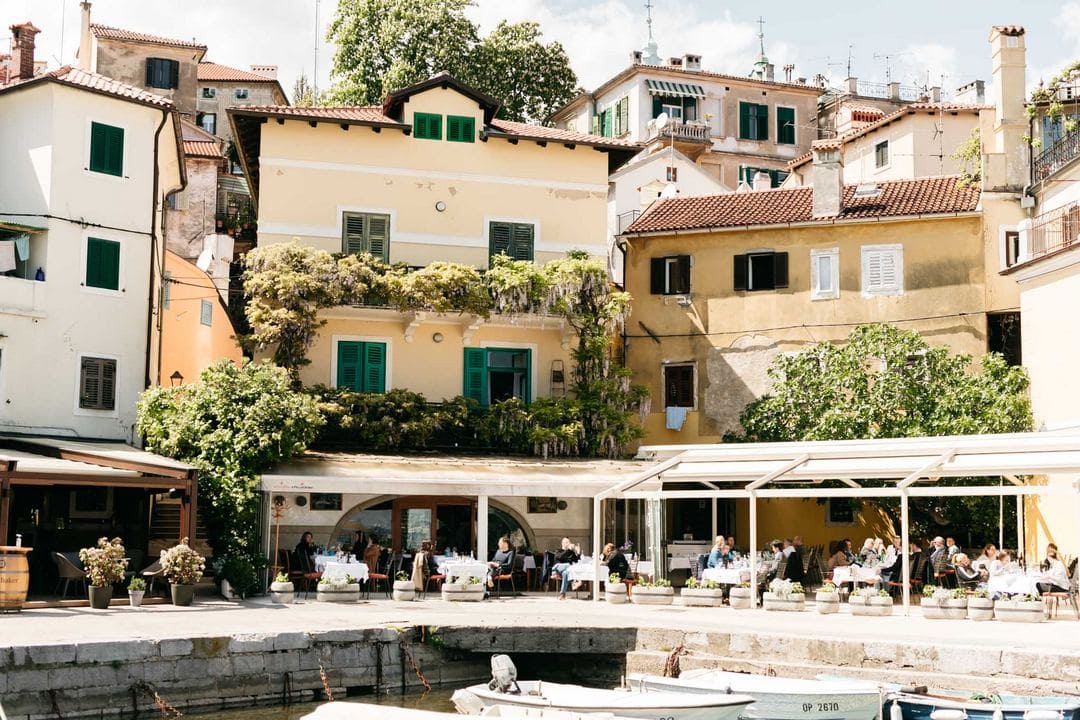
The appeal of a Mediterranean destination is also shaped by the life unfolding between its buildings. Morning coffee on the waterfront, a local shop, a fisherman returning to harbour and neighbours who know one another all create a sense of place.
These qualities cannot be replaced by a new façade or another amenity within a private property. They emerge from daily routines and relationships built over many years.
Kovačić warns that intensive tourism development can gradually erode this very foundation of a destination’s appeal.
“The problem arises when tourism becomes so successful that it begins to destroy the everyday life behind the scenes. At that point, tourism’s success starts to undermine its own product.”
He highlights South Tyrol as an example of a place that has preserved the relationship between tourism and local life. Its appeal also stems from its approach to nature, food, land and architecture. Residents maintain their traditions and livelihoods, while visitors have the opportunity to experience that way of life.
The relevance to Croatia’s coast is clear. A destination’s authenticity depends on how much room remains for the everyday lives of its residents.
What happens when a neighbourhood changes its purpose
In Kovačić’s view, the central problem arises when tourist accommodation becomes the dominant use within a neighbourhood or part of a town.
A house that once accommodated a single family becomes a holiday rental for ten or twelve guests. Every few days, the occupants, cars and patterns of activity change. Permanent residents find themselves living in an environment increasingly shaped around temporary visitors.
The consequences extend beyond noise. Neighbourly relationships, the mix of local services and the amenities available throughout the year begin to change.
“A town can have restored façades, full restaurants and record property prices while becoming increasingly empty. Not physically, but socially.”
This observation places rising property values in a broader context. The price per square metre reveals only part of the picture. A place’s quality as a home also depends on permanent residents, access to everyday amenities and the continuity of its community.
These are the qualities that shape the experience of those who wish to stay.
A property’s purpose shapes its development
.jpg)
A contemporary retreat with breathtaking panoramic views over the Adriatic - Crikvenica
The distinction between a home and a property intended for tourism begins at the planning stage. Its future use influences the layout, choice of materials, amenities and relationship with its surroundings.
Someone buying a home carefully considers how it will work in everyday life. Architecture, insulation, construction quality, privacy and integration into the neighbourhood all matter.
“A buyer purchasing a house to live in considers the architecture, quality of materials, insulation, functionality, how it fits into its surroundings and every detail. For a tourism product, the criteria are different. The number of beds, a swimming pool, appealing photography, occupancy and return on investment take priority.”
Kovačić emphasises that a property’s use for tourism does not automatically imply inferior construction. Different commercial objectives do, however, influence priorities and compromises during development.
The cumulative effect is particularly important. When large numbers of properties within the same neighbourhood are developed for short-term rentals, the character of the entire area gradually changes.
An individual development decision therefore becomes part of a much broader transformation.
Land as a finite resource
Speaking to Večernji list, Kovačić also considers European approaches to managing holiday homes and short-term rentals. He cites Tyrol, Switzerland and France as places using different measures to protect the residential role of their communities.
For Croatia, the underlying principle matters. How a property is used has consequences for its surroundings, and the availability of land calls for long-term planning.
“Land is not an unlimited resource. It matters whether a house serves as a home, a place for occasional stays or a property in continuous use for tourism.”
Solutions must reflect local circumstances. Istria, Opatija and Hvar have different needs, settlement patterns and levels of tourism activity.
Kovačić therefore stresses the importance of thoughtful management, particularly in locations where tourism has already substantially changed the conditions of everyday life.
Making more room for people who want to live here
Alongside more careful management of tourism pressures, Kovačić sees an opportunity to attract more people who wish to make Croatia their home.
A wealthy family spending most of the year here can support local services and contribute to the economy over the long term. Their presence also preserves the property’s residential role and allows lasting relationships with the community to develop.
“This does not mean choosing between residents and tourists. But it does mean deciding what balance we want between them.”
Such an approach requires a broader understanding of value. Alongside income from tourist stays, it is important to consider continuity of spending, use of infrastructure and the effects on neighbourhood life.
For the property market, this means paying closer attention to the kind of life a development makes possible and how it contributes to the destination around it.
The coast’s future begins with preserving its identity
Along Croatia’s coast, nature, architecture and local life come together in distinctive ways. The enduring appeal of these places depends on preserving that relationship as development continues.
Kovačić warns that more tourist beds and higher property prices can coincide with the erosion of everyday life. Future decisions must therefore also consider the quality of the communities they help shape.
“The Mediterranean’s greatest asset is not its real estate, but its way of life, which we must not lose.”
Established local amenities, neighbourly relationships and year-round activity give properties their wider setting. These are the qualities that encourage people to visit a destination and, ultimately, choose it as their home.
The next step for Croatia’s coast lies in development that recognises this connection and gives it a clear place in spatial planning.
Read the full feature in Večernji list.
October 14, 2026
Share
Related posts
-(15)-list_thumb.png)
Media
Croatia's new real estate brokerage law: what it actually changes, and what it doesn't - Ivan Kovačić for Forbes Croatia
-(20)-list_thumb.png)
Media
From Tina Turner to Christie's International Real Estate: Ivona Brnelić's journey
-(26)-list_thumb.png)
Media