All blogs
23.09.2026
Remington insights
Living in Istria as a foreigner: A practical relocation guide
For many foreigners, life in Istria begins long before the actual move. A few summer weeks turn into longer stays in spring and autumn, while familiar streets, restaurants and places gradually become part of everyday life. At some point, the question is no longer where to spend a holiday, but what it would be like to live in Istria throughout the year.
The region offers a natural setting for that transition. The coast and historic towns are always within reach, while the countryside brings vineyards, olive groves, more space and a slower rhythm. Italy and Slovenia are easily accessible by road, and Istria’s larger towns provide the services needed for everyday life.
Relocation, however, changes the way a place is viewed. A sea view may still matter, but so do the nearest doctor, school, winter opening hours, internet connection and travel time to the airport. These practical details often reveal the difference between experiencing Istria as a destination and making it a home.
The wider character of the region, its towns, landscapes and everyday rhythm is explored in more detail in The Istrian lifestyle: Hilltop towns, olive groves and life by the Adriatic.
Why foreigners choose Istria
The Adriatic is often what first draws international buyers to Istria. After spending more time in the region, their interest tends to broaden towards the qualities that make everyday life work: a mild climate, good road connections, gastronomy, active local communities and proximity to Central Europe.
Pula has the most distinctly urban rhythm on the peninsula. Its hospital, schools, shops, cultural programme and international airport make it a practical base for year-round living. Rovinj and Poreč offer a different balance, combining coastal life, established amenities and an international atmosphere. Rovinj, in particular, remains one of Istria’s most recognisable addresses.
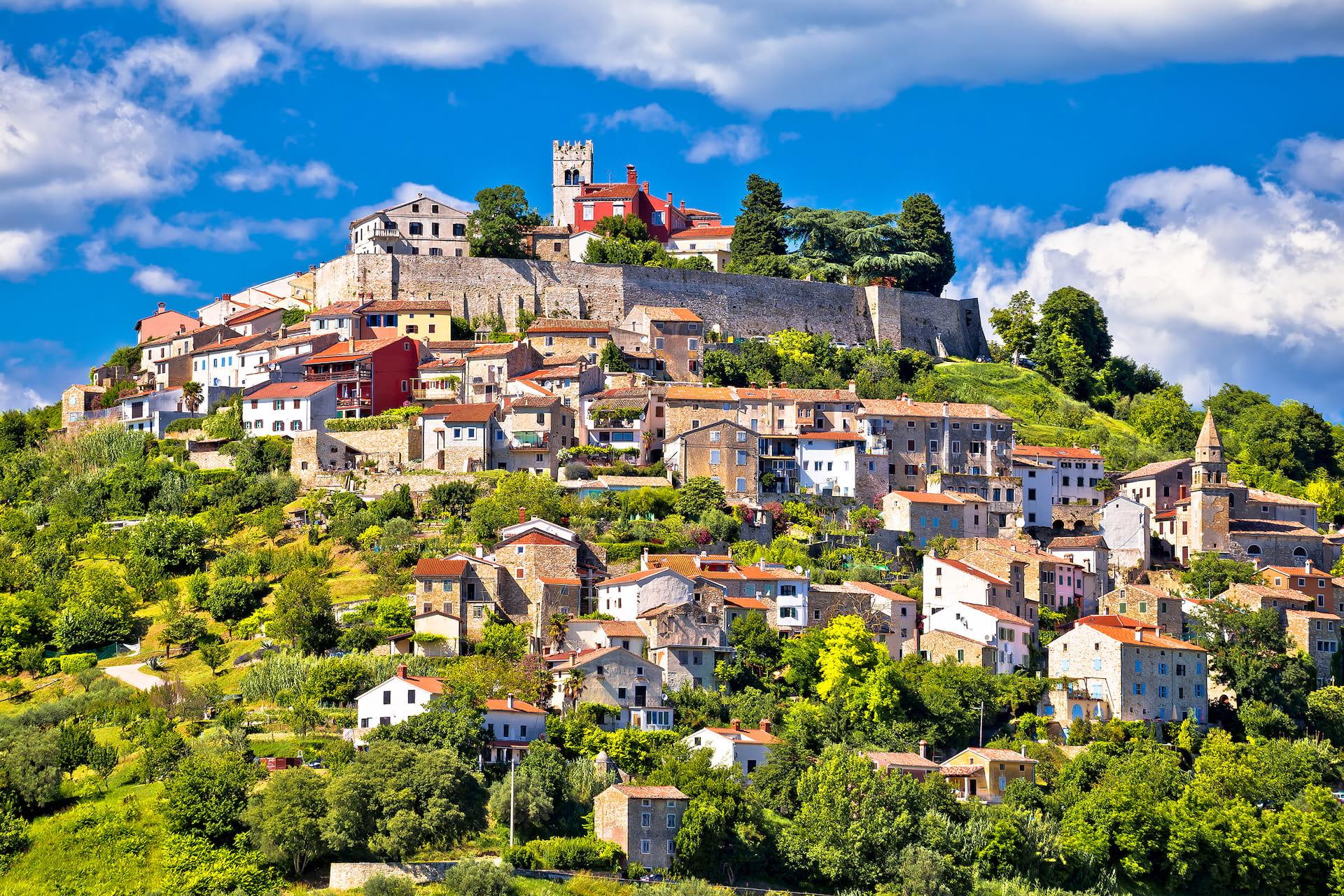
Inland Istria reveals a quieter side of the peninsula. Historic hilltop towns, vineyards, olive groves and larger plots appeal to those who value privacy and space more than immediate proximity to the waterfront. Buje, Motovun, Grožnjan and the surrounding villages are particularly interesting for buyers who want to remain connected to the coast while building their daily life in a more peaceful setting.
That variety is one of Istria’s defining advantages. Within a relatively compact region, it is possible to live in a town, by the sea or among vineyards without giving up access to infrastructure and international connections.
Cost of living in Istria
.png)
The cost of living in Istria Croatia cannot be reduced to a single monthly figure. It varies between Rovinj, Pula, Poreč and smaller inland communities, and depends even more on the type of property and the way it is used.
Housing, utilities, transport, insurance and regular maintenance form the basis of most household budgets. Families will also need to consider education, activities and healthcare. A villa with a pool, extensive grounds or an olive grove naturally comes with a different cost structure from an apartment in town.
Seasonality also plays a role. Coastal towns change rhythm during the summer months, traffic becomes more intense, and some services and prices follow the tourism season. These differences tend to be less pronounced inland.
For this reason, some foreign buyers choose to rent long term before purchasing. Several months spent in the same location can provide a much clearer picture of real costs and everyday habits than a series of short stays.
Rent first or buy immediately?
.png)
Peaceful retreat: stylish villa with pool, sauna and complete privacy
A property that works perfectly in August may not necessarily work equally well in January. This is particularly relevant for buyers who know Istria primarily as a summer destination.
A longer stay reveals details that are difficult to notice during a property viewing. How long is the school run? Where is the nearest pharmacy? Does a favourite restaurant remain open in winter? How often is the car needed for even the simplest daily errands?
These questions become even more important inland, where greater privacy often comes with greater distance from everyday services. Renting before buying can therefore give some buyers the time they need to understand a micro-location before making a long-term commitment.
“International buyers often know Istria very well as a holiday destination before considering a permanent move. The right property should support everyday life, family requirements, work and long-term plans. Understanding the micro-location is therefore just as important as understanding the property itself.”
- Ivan Kovačić, Managing Director, Remington Real Estate | Christie’s International Real Estate
Healthcare as part of the relocation decision
Healthcare is rarely among the first considerations during a holiday. When planning a permanent move, it becomes one of the essentials.
Croatia’s public healthcare system is administered by the Croatian Health Insurance Fund, or HZZO. Primary care includes family medicine, paediatrics, women’s healthcare, dental care, pharmacies and laboratory services. Specialist and hospital care is generally accessed through a primary-care physician, while the nationwide emergency number is 112.
Rights and obligations vary according to nationality, residence status, employment and existing health insurance. Citizens of the EU, EEA, Switzerland and the United Kingdom may, depending on their circumstances, have access to healthcare under European coordination rules. Anyone planning a permanent move should separately confirm the registration and insurance requirements that apply to their situation.
Location once again matters. Pula offers the broadest healthcare infrastructure in Istria, while residents of smaller towns and rural areas should consider the distance to a doctor, pharmacy and hospital. Current information on healthcare rights and insurance is available through the Croatian Health Insurance Fund.
Schools and family life
For families, the map of Istria is often viewed from an entirely different perspective. Distance to school, the daily commute and the language of instruction can influence the choice of home more than distance to the beach.
Children arriving from abroad can continue their education within the Croatian system, subject to the relevant enrolment procedures. Istria also has a long tradition of bilingual education. Italian-language schools operate in several Istrian towns, including Pula, Rovinj and Buje, reflecting the region’s strong Croatian-Italian cultural identity.
Families looking for an international curriculum can also consider Koper International School in neighbouring Slovenia. Koper is particularly accessible from northern Istria, and the school follows a British curriculum with most teaching conducted in English.
It is therefore useful to explore schooling options before making a final property decision. A daily route that appears short on a map can have a significant influence on family life during the school year. Official information on enrolment in Croatian primary schools is available through the Croatian Government portal.
A language that opens up everyday life
English is widely spoken in Istria’s tourism centres and larger towns, while Italian is deeply woven into the region’s cultural identity. For many foreign residents, this makes the first months of living in Istria relatively easy from a communication perspective.
Croatian, however, changes the quality of everyday life. Even a few basic phrases can make administration, conversations with local tradespeople, visits to the market and communication with neighbours easier. Over time, the language becomes less of a practical necessity and more of a way to connect with the place itself.
Remote work between the coast and countryside
Istria naturally appeals to professionals whose work is no longer tied to a single location. A working day can unfold from a house in the countryside, an apartment in Rovinj or a villa a few kilometres from the coast, with a rhythm very different from that of a large city.
A reliable internet connection matters more than the impression created by the location itself. Availability and speed should always be checked at the exact property address, particularly for secluded houses and rural properties.
Croatia also has a regulated temporary residence framework for qualifying digital nomads from third countries. Current requirements are available through the Croatian Ministry of the Interior.
Istria between the Adriatic and Central Europe
.png)
Connectivity is one of the reasons Istria works well as a year-round base. The Istrian Y motorway connects Pula with the central and northern parts of the peninsula before continuing towards Slovenia, Rijeka and the wider Croatian motorway network.
Pula Airport lies approximately five kilometres from the city and connects Istria with a range of European destinations during the main travel season. Residents who travel throughout the year have a wider choice. Trieste and Ljubljana are particularly practical from northern Istria, while Rijeka, Venice and Zagreb provide additional options depending on the starting point and destination.
The sea also remains part of Istria’s transport network. Seasonal passenger services connect Venice with Umag, Poreč, Rovinj and Pula, while catamaran routes from Pula provide connections to selected Croatian islands and Zadar. The ferry from Brestova connects Istria’s eastern coast with the island of Cres.
For owners who travel frequently, an additional twenty or thirty minutes to a motorway or airport can become significant over time. Accessibility is therefore more than a practical detail; it forms part of the quality of a micro-location.
Istria beyond summer
The best way to understand whether Istria is suitable for permanent living is to spend part of the winter here. July and August reveal the region’s energy, but November or February show its everyday rhythm.
Traffic becomes lighter, beaches are almost empty, and some seasonal restaurants and businesses temporarily close. Larger towns such as Pula, Poreč and Rovinj retain essential services, while smaller communities become considerably more intimate.
This is also when details that are easy to overlook in summer become apparent. Winter sunlight at the property, driving time to the nearest shop, access to an open pharmacy or the quality of the approach road may ultimately matter more than the view that first attracted a buyer.
Before moving to Istria
.png)
Elegant modern villa with pool and sea view - Pula
Before making a final decision, it is worth considering several practical questions:
What should I check about residence requirements?
Residence rules depend on nationality, the purpose of your stay and how long you plan to remain in Croatia. These requirements should be clarified before making a long-term move.
How should I plan healthcare?
Check which health insurance rules apply to your situation and how easily you can access a doctor, pharmacy and hospital from your preferred location.
What should families consider when choosing schools?
Look at the available schools, language of instruction and daily travel time. For international families, the school choice can significantly influence the most practical residential area.
What property costs should I calculate?
Consider the real annual cost of ownership, including utilities, insurance, maintenance, garden or pool care and other recurring expenses.
How important is internet connectivity?
For anyone working remotely, it is essential. Internet quality should always be checked at the exact property address, particularly in rural areas.
Are shops and services available all year?
This depends on the location. Larger towns generally retain more year-round services, while smaller coastal areas may become much quieter in winter.
What due diligence should be completed before buying?
Legal ownership, permits, technical documentation and the overall condition of the property should be reviewed before the purchase is completed.
When Istria becomes more than a destination
For many foreign owners, the relationship with Istria develops gradually. It begins with summer visits, followed by the discovery of spring and autumn, while stays become longer from one year to the next.
As that relationship changes, so does the way a property is viewed. Heating, storage, parking, reliable internet and proximity to everyday services gradually carry more weight than features designed primarily for holidays.
This is perhaps where Istria’s lasting appeal becomes most apparent. It can be a place for a few summer weeks, a second residence that owners return to throughout the year, or a home where everyday life gradually takes root.
For many international owners, that journey begins with owning a holiday home in Istria. Over time, familiar places cease to be simply part of a journey. They become part of routines, relationships and future plans — and Istria becomes home.
September 23, 2026
Share
-list_thumb.jpg)