
All blogs
27.08.2026
-(7)-thumb.png)
Real View
What happens when buyers cannot afford more - and developers cannot build for less?
Croatia’s property market is entering a new phase. Transaction volumes are falling sharply, property prices continue to rise, and at the same time fewer building permits are being issued. That last development is not particularly surprising. After several years of rising land, construction and financing costs, it was, in fact, fairly predictable.
In the first six months of this year, 14.3% fewer building permits were issued than in the same period of 2025. Those permits provide for the construction of 8,902 residential units, 14.6% fewer than a year earlier. At the same time, residential property transactions in the first quarter fell by 42.2% year on year. Achieved sale prices rose by 14.3%, while prices along the Adriatic increased by 12.6%.
At first glance, the data may appear contradictory: fewer properties are selling, yet prices continue to rise. However, a market correction does not have to take place solely through falling prices. It can also occur through lower transaction volumes, postponed developments and, with a certain time lag, weaker residential construction activity.
Development economics are becoming increasingly difficult
.jpg)
This has already been visible in the market for some time. During and immediately after the Covid period, a large number of developers entered Croatia’s coastal second-home, premium and luxury segments. Demand was exceptionally strong, particularly from Germany and Austria, prices were rising, and developments that might not have been viable only a few years earlier suddenly appeared commercially sound.
Today, the economics look very different. Land is more expensive, labour costs have risen significantly, financing is no longer available on the terms seen during the era of near-free money, and construction costs remain very high. Building material prices in Croatia were 4.3% higher in July than a year earlier. More importantly, they were as much as 33.1% above the 2021 average.
This brings us to an issue that is often overlooked in discussions about “overpriced apartments”. A final asking price may appear very high while the development itself still fails to generate a particularly attractive return for the developer.
Buyers can no longer keep pace with rising prices, while developers have limited room to reduce them significantly.
As those two limits move closer together, prices are not necessarily the first thing to fall. Transactions disappear first. Developers then postpone new projects. Eventually, the number of building permits and active construction sites declines.
The early stages of that process are now becoming visible.
The second-home market is already becoming more selective
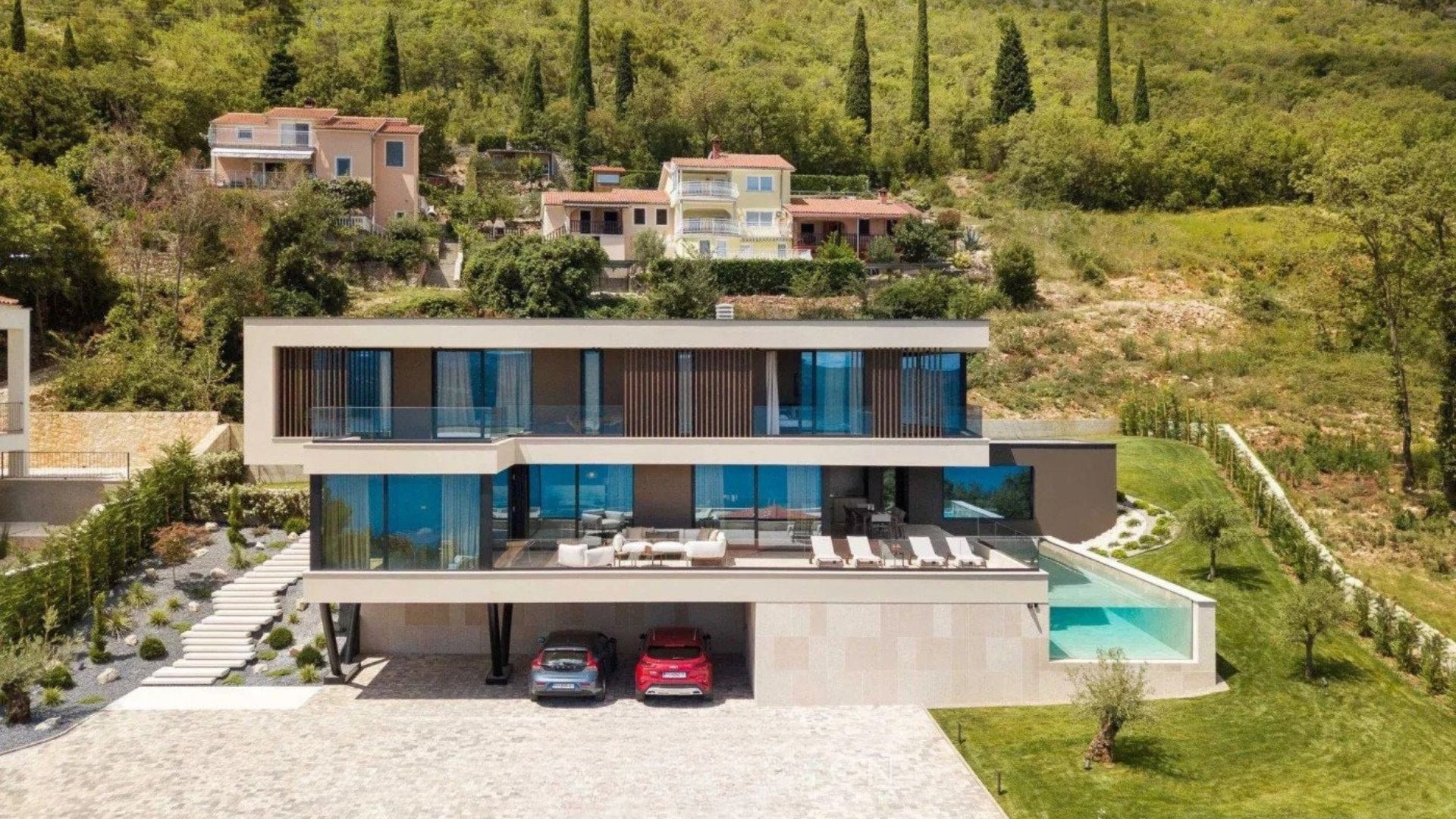
This process is even more apparent along the coast. Germany and Austria, which for years formed the backbone of strong demand in Croatia’s second-home market, no longer have the momentum seen during the previous cycle. Other markets are emerging – Slovenia, Poland, the Czech Republic and Hungary – and some are showing encouraging growth. However, it is difficult to expect them to replace German demand purely in terms of volume.
As a result, some developers who entered the premium and luxury segments during the boom are already beginning to withdraw. That is not necessarily a negative development. The market is now carrying out a process of selection that arguably should have happened earlier.
A very strong product in an exceptional location can still justify its price and deliver an appropriate return for the developer. An average product in an average location carrying a premium price is becoming far more difficult to sell.
In the next cycle, simply building an expensive property will no longer be enough. There will need to be a clear reason why it commands a premium.
That shift can be viewed as healthy. The problem is that its broader consequence may be a reduction in new supply.
Lower supply will not make housing more affordable
This is where the paradox becomes clear. On the one hand, policymakers quite rightly speak about the need for greater housing supply and improved affordability. On the other, current market data is moving in the opposite direction.
If fewer projects are being launched while development costs remain high, it is difficult to see how the market alone can produce a substantial decline in new-build prices. Individual developments and locations will, of course, see price adjustments. It is also important to continue distinguishing between advertised asking prices and achieved transaction prices, as the gap between the two remains significant in the Croatian market.
But expecting a broad-based correction in prices while future supply is simultaneously shrinking appears overly simplistic.
There is also another uncomfortable variable. The crisis around the Strait of Hormuz in 2026 demonstrated how quickly geopolitics can once again translate into higher construction costs and a higher cost of living across Europe. The European Commission and the IEA have warned about the impact of disruptions to energy flows, while the ECB estimates that the energy shock has not yet fully passed through to consumer prices. Eurozone inflation stood at 2.8% in June, while the ECB has warned that energy costs could keep inflation above target through the first half of 2027.
For real estate, this creates a difficult combination: more expensive inputs, weaker real disposable income and financing conditions that may remain restrictive for longer.
Then there is what can actually be changed
There is little that can be done about the price of oil. The direction of the German economy is also beyond Croatia’s control. But the way land and urban space are developed is something that can be influenced.
If the objective is to increase housing supply meaningfully, changing legislation or announcing faster permitting procedures will not be enough. There is still no visible shift on the ground of sufficient scale to materially increase the number of well-prepared development projects. And that will not be possible without the active involvement of local authorities.
This is not a simple problem. Quite the opposite. But without better urban planning, more detailed development frameworks, properly resolved infrastructure and a clearer permitting process, it is difficult to expect a meaningful increase in supply. Urban planning sits at the beginning of the entire development value chain, yet for too long it has been treated as an administrative obstacle rather than a development tool.
The decline in building permits is therefore not particularly surprising. The more important question is whether this will prove to be a few weaker months or the first statistical evidence of a more significant shift in the market cycle.
The expectation is that over the next two to three years Croatia could see fewer new developments, far greater selectivity among them, and an increasingly visible divide between properties that still make commercial sense and those that no longer do.
Perhaps the biggest problem facing Croatia’s property market will not be that real estate has become too expensive. It may be that, at prices buyers can realistically afford, it will soon no longer be sufficiently profitable to build.
Blog author: Ivan Kovačić
August 27, 2026
Share
-list_thumb.jpg)
-(9)-list_thumb.png)
-(5)-list_thumb.png)